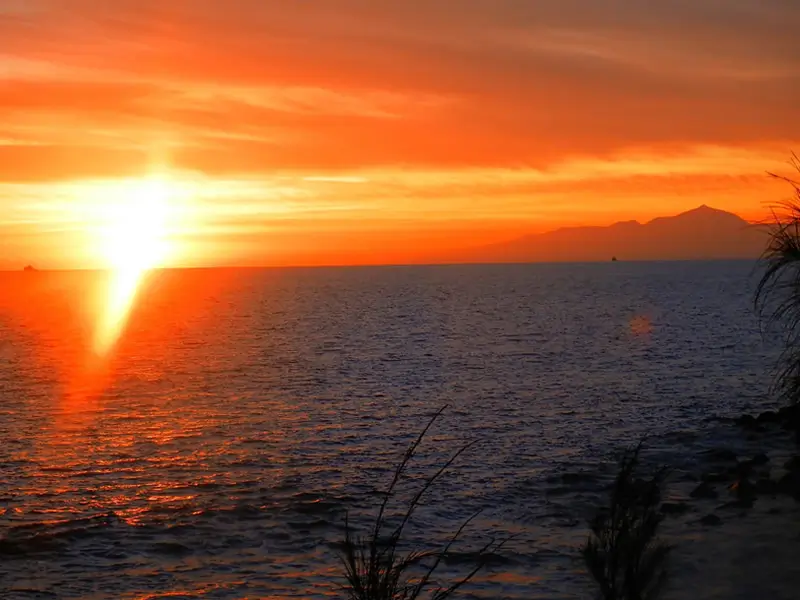


Many of those who walk and enjoy this coast ask themselves the same question. The origin of the name Arguineguín hides a story that takes us back to the time of the ancient Canarians; a word that defines the identity of this corner of the south of Gran Canaria.
Do you want to know the origin of the name Arguineguín?
We say it every day. “I’m going down to Arguineguín”, “Let’s meet at the Arguineguín pier”. But have you ever stopped to think about what it really means? Because it’s not Spanish, that’s for sure.
If you ask the village elders, they will tell you one thing. If you ask a historian, they will tell you another. And the curious thing is that, probably, everyone is a little bit right.
Arguineguín is not just a beautiful name; it is an enigma that has been here for more than 500 years, long before tourists arrived or hotels were built. Let’s see where it really comes from.
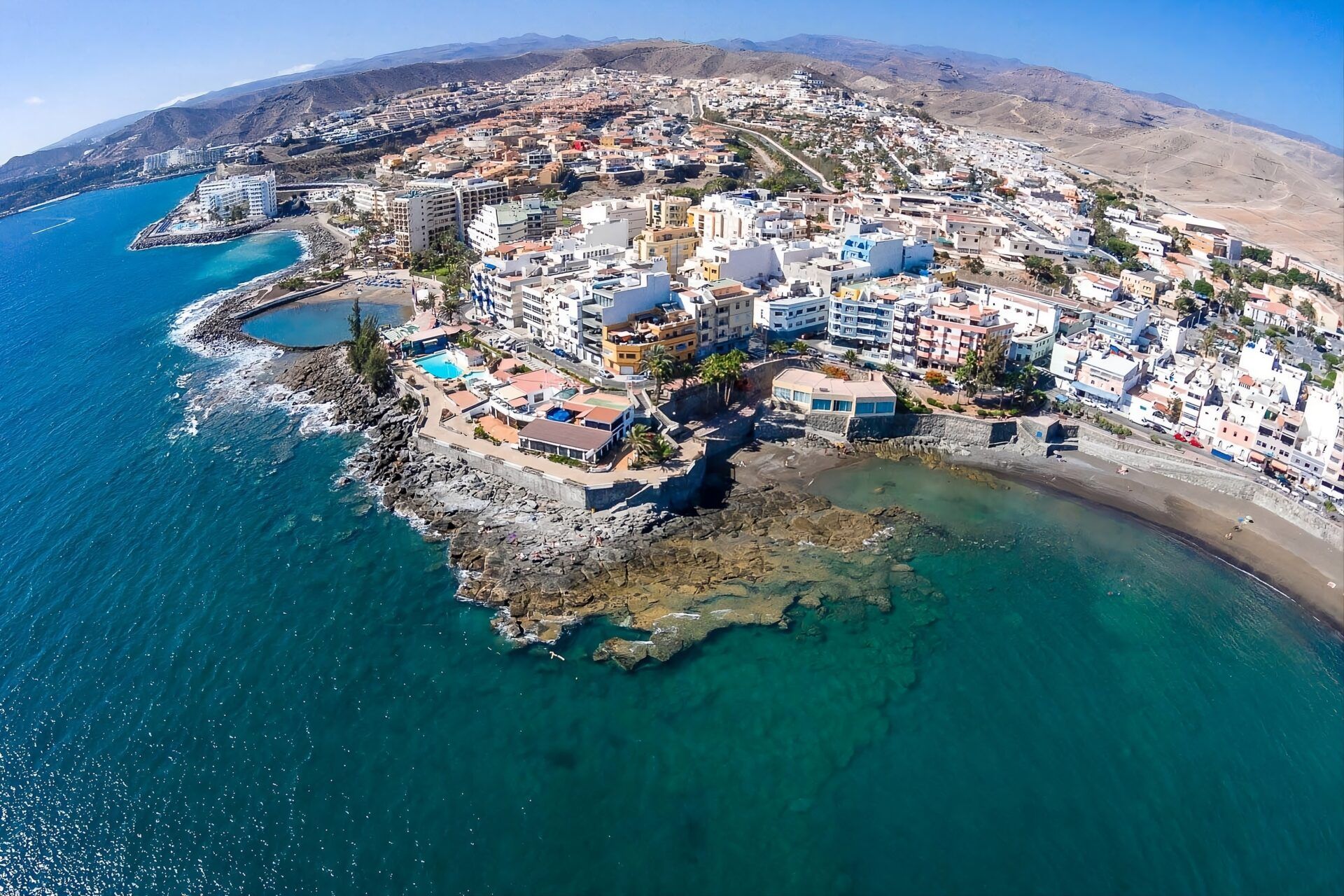
The scientific theory: The African “twin”
This is the one defended by experts, and it makes perfect sense if you look at a map.
If you go about 800 kilometers south, on the coast of Mauritania, there is a place called the Banc d’Arguin. Does it sound familiar? Well, it’s no coincidence.
The ancient Canarians (the aborigines) came from North Africa and brought their language with them. In that Berber language, the word “Arguin” was used to describe coastal areas with very calm waters, peaceful bays where the sea does not hit hard.
And the end of the word, “-eguín”? Linguists believe it means “place of” or “small”. So, if we put the pieces together, Arguineguín would literally mean “The place of calm waters”.
And if you look at this coast, it fits the description perfectly: it is one of the few areas in the south where the north wind does not punish you and the sea looks like a mirror.
The local legend: “Agua de Ley” (Water of Law)
This is the version that you have surely heard from your grandparents or from the people of the sea, and it is beautiful.
For centuries, it has been said that the name came from “Agua de Ley”. Why? Because in the past, in this dry area of the south, the Arguineguín ravine flowed with very high-quality fresh water. It was a treasure.
Ancient chronicles (such as those by a man named Abreu Galindo, who wrote shortly after the conquest) said that noble aborigines (the Guayres) lived here and that the water was so good it was “de ley,” meaning pure, authentic, and of the best quality.
Even if scientists say that “Arguineguín” is not literally translated this way, this story is important because it tells us how the village saw itself: a valuable place, with unique resources and noble people.
Even if scientists say that “Arguineguín” is not literally translated this way, this story is important because it tells us how the village saw itself: a valuable place, with unique resources and noble people.
More than an origin, it’s a feeling.
100% Cotton • Minimalist, durable, and extra soft.
The curious Basque connection: Was “light made” in Arguineguín?
There is a fascinating theory, although less supported by historians, that links the name with the Basque language. According to this hypothesis, Basque fishermen who worked in the Atlantic long before the Castilian conquest would have named the area by combining two words from their language: “Argi” (light) and “Egin” (to make/do).
Does this mean that Arguineguín is the place where “light was made”? Although for linguists the Berber origin is more likely, this interpretation has gained affection over the years. After all, anyone who has seen a sunset from the pier knows that if there is a place in the world where light makes sense, it is here.
The footprint of the guardians and the nobility
There is another possibility that mixes the name with the history of the ancient Canarians. It is said that the end of the word, «-eguín», could come from a root meaning “guardians” or “canines”.
Although it is difficult to know for certain, the idea makes sense if we look back. Before the conquest, this area was so important that Queen Arminda resided here. For this reason, many think that Arguineguín was the place where the guardians protected the royal family in this very special corner of the coast.
Whether or not it is the real origin, it is nice to think that this place was already important more than 500 years ago and that, in some way, that essence of a special site has been maintained until today.
Walking today along the beaches of Arguineguín is, literally, stepping on royal ground. This was Queen Arminda’s favorite refuge, and that energy is still felt when walking by the sea.
The perfect refuge (and why the name never changed)
Think about it for a moment: when the Castilians conquered the island, they changed the name of almost everything. Many places were given saints’ names (San Bartolomé, Santa Lucía…).
But with Arguineguín, they couldn’t. The name stayed.
Why? Because for sailors and fishermen, this name was vital. Arguineguín was the exact point on the map where they knew their boats were safe. Archaeologists have found enormous remains under the current town that prove that many people lived here before the conquest. It was a kind of “capital” of the south.
The name had such strength and was so well known by the people of the sea that no one dared to change it. It has survived wars, conquests, and the passage of time exactly as we say it today.
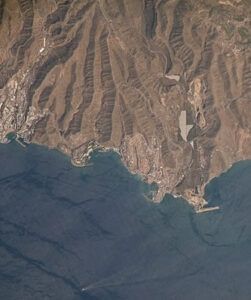
Arguineguín
27°45’43″N 15°40’59″W
💡DID YOU KNOW THAT…?
“In the oldest maps from the 16th century, the name appeared written in very varied ways: ‘Arganeguin’, ‘Arguinegi’ or even ‘Ergueneguin’. This confusion among European cartographers demonstrates how difficult it was for them to transcribe the original Canarian sound, but also how important the place was for everyone to try to include it on their maps.”
Which one should we keep?
In the end, it doesn’t matter if you prefer the “Calm Water” theory (the Berber one) or the “Agua de Ley” theory (the popular one). They all say the same thing about this magnificent village:
Arguineguín has always been a refuge. A place where the sea calms down, the water is good, and people feel safe. And that, 500 years later, has not changed.
The origin of Arguineguín was written by the ancients, but its present is written by you. In our Thanks section, we have created a space to share the love and passion for this corner. We invite you to discover the feelings and experiences of those who visit us and the mark that Arguineguín has left on them. If you have your own story that you would like to preserve, we would be delighted for it to be part of it.
Arguineguín. Slow Life. Gran Canaria.
Un tributo al estilo de vida de Arguineguín. Identidad sin fecha de caducidad. Calidad superior y estilo minimalista para quienes valoran lo que nace para quedarse.
The most widely accepted scientific theory indicates that it comes from Berber (the language of the ancient aboriginals) and means «Place of calm waters». This root matches the toponym Arguín in Mauritania, which describes protected bays where the sea remains calm, a description that fits perfectly with the Mogán coast.
This is the most cherished popular interpretation. Although linguists do not consider it the technical root, it was historically called this because the Arguineguín ravine flowed with fresh water of exceptional purity. For the ancient Canarians, it was such a valuable resource that it was considered “de ley” (authentic and of the highest quality).
There is a fascinating hypothesis that links the name to the Basque words “Argi” (light) and “Egin” (to do). It is believed that Basque fishermen who worked in the Atlantic before the conquest may have named it the place where “light was made,” due to the spectacular clarity of its sunsets.
Unlike other places in Gran Canaria that were renamed after saints, Arguineguín kept its original name due to its enormous strategic importance. For the sailors and fishermen of the time, the name was a vital reference on maps for locating the safest maritime refuge in the south of the island.
Queen Arminda was one of the noblest figures in the pre-Hispanic history of Gran Canaria. Arguineguín was her favorite place of residence and refuge. Walking along its beaches today is to step on what was once an aboriginal “capital” and the home of the Canarian nobility (Guayres).
On 16th-century maps, it was common to find variants such as Arganeguin, Arguinegi, or Ergueneguin. This was because European cartographers had difficulty transcribing the phonetic sounds of the Canarian aboriginal language. However, the fact that they all tried to include it proves that it was the most important landmark in southern Gran Canaria for transatlantic navigation.
Beneath the town’s current center lie the remains of one of the largest aboriginal settlements on the island. Excavations have revealed that before the conquest, Arguineguín functioned as a kind of coastal capital, with large dry stone structures that took advantage of the ravine’s mouth and the area’s rich fishing.